
Tag Archives: brain surgery

Brainstorm – Part One

By now, I hope you have noticed one common theme in all of my entries – if you haven’t yet, you’ll have to wait until part two of this post for the revelation…

At the age of 8, I began playing the piano and taking lessons. I grew up with the piano that my mother took piano lessons on and which I learned to play. Those of you who know me, you can attest to the fact that when I put my mind to something, I am determined to do it and do it well; it was the same way with my piano lessons.

After returning home from Rhode Island in May of 2008, I began writing an original composition. When I played the song, my parents asked me what it was and I replied that it was a song I was writing but that needed an ending. My family proposed some names and ideas, but none of them were what I was looking for – I needed to brainstorm.

As Stephen touched upon in his toast at my wedding, one day in late August, the doorbell rang and it was our good family friend, Caryl. Sadly I say that I do not recall much else about Caryl’s visit other than me playing the piano for her. But looking back at it, I am beyond grateful she asked. Up to that point, I had not played too much as I grew far too frustrated with myself and my inability to play. But she did not care – she knew I had it in me and just believed in me. With Caryl and Stephen watching and waiting for me to do something, I sat down at the piano and took a deep breath and began to play. I managed to play as much of the song as I had written. I’m sure it was chock full of wrong notes and whatnot, but I had done it. A major accomplishment? No. But an accomplishment for me? Absolutely.

The date was sometime in late August 2008 and things were still going downhill for me. I was making absolutely no progress in my recovery. My ventricles were still clogged from debris where the tumor sat and the hydrocephalus was acting as a crux in my quest to recover.  After all, that’s what hydrocephalus is – a condition in which cerebrospinal fluid (CSF) builds up in the ventricles. Thus, the time had come to decide whether we would pursue the implantation of a shunt.

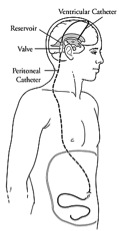
If you’re wondering what a VP shunt is, fret no more. The easiest way that I can describe it is as a device that allows excess CSF built-up inside the skull to drain into the abdomen.  One incision is made in the back of the skull to insert the reservoir and valve deep within the brain and then one incision is made in the abdomen to place the drain where the CSF would release. Tubing was implanted under my skin to connect the valve to the drain. So, to connect the dots…when the pressure of CSF builds inside the brain, the valve opens, the excess fluid flows down the drain through my head, into my neck and eventually drains down into my abdomen. Brain juice!UntitledDecision Time
Up to this point, my biggest decisions were what I would eat and which couch I would lay on for the day.  When it came time to ultimately decide whether to pursue the shunt operation, I made my voice heard. I was yearning to break free. I knew this was my only hope and the best option.  However, my parents had some remaining questions….

On the Saturday before Labor Day, I had a call with Dr. Piepmeier.  Karen and I were debating back and forth the pros and cons of the potential shunt surgery, which had been whispered about since the initial surgery.  The concern was that when Chris was initially admitted to Yale almost 8 weeks ago, he was already suffering from hydrocephalus.  This was the most puzzling part of the situation to the medical staff…how was he even functioning?  After 6 weeks of rehabilitation, almost no progress was made and the latest MRI showed that the ventricles were blocked and swollen, and the hydrocephalus was still present.  Dr. Piepmeier and I then discussed the options, which were: (1) stay on course to see if the healing process would correct the situation or (2) to have the shunt inserted.

We then talked about odds and percentages.  After insertion of the shunt, approximately 80% of the patients will see improvement in their cognitive function within 6 months to up to 2 years…15-20% regain total cognitive function within 6 months…and a very small percentage, 1-2%, has an immediate cure overnight.

We also discussed the potential risks.  We were advised that there was potential for the development of a blood clot in the brain, swelling in the brain, infections and seizures. In addition, we were also told that there is a risk that the shunt could malfunction at some point and also that the shunt system would need to be replaced once, twice or even three times throughout Chris’ life.  But just what if, in a miracle circumstance, Chris was the 1-2% case and the procedure worked without any unintended consequences and aided his recovery process?

I then asked him what I still believe was the right question: “if Chris was his son, would he do the surgery?”  His answer was an immediate yes.  My vote was now to do the surgery.

With all that I had been through up to this point, I felt that I had nothing to lose. I considered this to be the easiest decision I had been asked to make up to this point. I understood all of the risks and was realistic that even if the procedure went without any issues, it would still be a long road ahead. I knew that it was likely that no results would be seen for quite some time, but I knew my body better than anyone. The flash cards, ABC chart, workbooks full of addition and subtraction problems, the paper we all used in 2nd grade to practice writing in between the lines, etc. were simply not working. But more importantly, I was getting tired of being trapped inside my own body.

It’s Go Time!

On September 8, 2008, I underwent surgery for the implantation of the VP shunt. The surgery was scheduled to take place early in the day which meant prep for the surgery began very early and which also meant I had to begin fasting the night before. As luck would have it, the procedure continually got bumped as other cases had taken priority over mine…I was getting restless…anxious…and extremely hungry. Finally, around 4:30 in the afternoon, I was wheeled into the OR…


Blinded By The Light

Freezing and bright.  That is what I remember the operating room being like right before being put out for my surgery to remove my tumor.  Sort of reminiscent of an alien abduction – or what I imagine it would be like.  I’m not sure which I would prefer – the abduction or the surgery, but I do remember trying not to look around too much in fear that I would see the tools and instrumentation that would be used to rip into my skull and remove the tumor.  I was greeted by smiling faces from the doctors and neurosurgeons, giving me reassurances that all was going to be okay.  Within minutes of being there, the anesthesiologist was ready to get started and I was instructed to begin counting backwards…

“10, 9, 8” is all I can remember.  I was confident going into the operation, but I would be lying if I said I was not scared that I would not wake up, so when I opened my eyes and saw my family by the bed, it was exhilarating. Everyone can relate to that moment where they wake up from a deep sleep and you have someone talking to you, but waking up from anesthesia after nine hours of brain surgery was overwhelming.  Despite my joy that I actually woke up, it did not take me long to understand what a hurdle this was going to be.

Within a matter of a month, I had gone from taking law school final exams to trying to string together a coherent sentence in response to the hospital’s favorite question: “are you in any pain?” I felt like responding, “No, no pain at all.  I just had my head cracked open and rummaged in.  I have tubes and a catheter protruding from my head, but no, no pain.”  Normally, I would whip out this sarcastic response in a heartbeat, but even attempting to actually verbalize this response was impossible.  I remained confident and did my best to mutter something, anything.   My naming (ability to identify people and objects) was intact and my strength was average.  However, my speech was minimal and it was clear that I was suffering from hydrocephalus, also known as “water on the brain”, a condition in which the cerebrospinal fluid builds up within the ventricles.

It’s crazy – to me, everything that I said to my family and the doctors at that time made perfect sense to me, but I was later told that what I was saying was not making any sense whatsoever.  I can relate a lot to someone who suffers from locked-in-syndrome.  But I’ll save that for another day.

On the morning of July 6, 2008, four days after the tumor was removed, my father came to the hospital early in the morning to check in on me, just as he had done the previous three days.  One day earlier, the drain that was put in to drain the CSF fluid and the catheter were removed and I was progressing better than expected. The doctors were so pleased with my progress and everything was on schedule for me to go home within a day or two.  And to top things off, my uncle came to visit and brought breakfast – yes, Italian pastries.  I watched as my father and uncle devoured them.  I could only watch.

As I sat in bed reading words that I recognized in the sports section of the newspaper, things suddenly began to deteriorate.  I started having trouble conversing and began having severe headaches, nausea and vomiting, and my heart was racing as if it was going to beat out of my chest.  The room was spinning and I was sweating bullets.  I suddenly could not move the right side of my body.  Thoughts were racing through my mind at such an alarming pace that I cannot even begin to spell them out, but I knew something was drastically wrong.  I heard my father shouting for the nurses and the sound of the brain activity machine was beeping manically.  Within a span of a few minutes, I had lost all of my motors skills and was manifesting the symptoms of a stroke.

At this point, my mom had arrived at the hospital along with my sister and brother.  I saw everyone crying and yelling as I lay in the bed with my body seizing and unable to communicate or express myself in any meaningful way to let them know I would be okay.  I had only wished I had a way to tell them not to worry, even if I did not believe that myself.

As I was wheeled out of my hospital room, my brother and sister said their goodbyes to me because they were afraid they would never see me again.  Both my mom and dad were running down the hall next to my bed as I was wheeled into the OR.  Just as we parted ways, my mom gave me a kiss and told me she loved me and my father took my hand, squeezed it and asked me to squeeze his hand if I understood.  Pathetically, I squeezed his hand and it was at that moment that we all knew I was going to make it out of this procedure and live to tell this story.

Send In The Clowns

Any one who has gone through an emergency procedure knows the whirlwind it becomes.  Upon hearing the information I had long suspected I would hear, I was immediately rushed to Yale-New Haven Hospital where Dr. Joseph Piepmeier, head of Neuro-oncology, and his staff would be waiting.   Once I arrived, life was moving at an alarmingly fast pace.  There were questionnaires to fill out, identification bracelets to put on and doctors coming in and out of the examination room.

As Yale-New Haven is a teaching hospital, there were many graduate students that came into the room at the direction of the neurosurgeons and each asked the same questions over and over and over.  My favorite one of all was “What kind of pain are you in?  Any headaches?”  Seriously?!?  I first hoped that maybe this was all a bad dream and I was merely guest starring in an episode of Grey’s Anatomy.  Once that hopeful thought fled, I felt like replying, “no, I’m here because I like the hospital food.”  Once that barrage was over, in comes Dr. Piepmeier.  He was followed into the room by his chief resident, fellow neurosurgeons and the clinical care coordinator.  There was something about Dr. Piepmeier that calmed me – he had this glow to him, almost as if the moment I saw him I’d knew he would be able to help me.

I was then briefed on the situation – I had a tumor sitting in the ventricular system that displaced the septum pellucidum.  The procedure was described to me and I was told where the incision would be made.  Now, I’m a fairly bright kid.  I graduated UConn cum laude and had one year of law school under my belt so, I had heard my fair share of crazy latin terms.  But “ventricular system”, “cortical incision” and septum pellucidum?  He looked at me and said “any questions so far?”  I shook my head no, but if I were really on top of my game, I probably should have said “yes, do you have a medical dictionary?”  Between all the doctors in and out, the questions and medical jargon, I felt like I was at the circus – not quite Barnum & Bailey’s though – more like a creepy, frightening Cirque de Soleil.

I was then informed that emergency surgery was scheduled the next morning and it was my doctor’s hope that the entire tumor could be removed.  I signed the consent…as if I had any other option…and with that, a few questions were asked and the doctor was on his way and told me he’d see me in the morning.

Stunned and scared, I did not know what to do or what to say.  Shortly after, a nun from the hospital Chapel came into my room and asked whether she could pray with my family and I.  This is the moment that “it” all became very real to me and I knew that I needed God in this time of trouble.  I cannot even describe the thoughts that were going through my head at the time because I honestly do not even remember.  I was in such shock that this was happening to me.  The only question I remember asking the nun and my parents was “why me?” and nobody had the answer.